Website Design On This Page
Website design should make the business easier to understand, compare, and contact.
For many companies, the website is where a potential customer decides whether the offer feels credible enough to call, submit a form, request a quote, schedule a visit, or keep comparing options.
WDAC designs websites around that decision path: the message, navigation, content hierarchy, proof, mobile experience, and inquiry flow that help visitors move from interest to action.
St. Louis Website Design
Website Design for the Markets WDAC Serves
Designing for a St. Louis business does not mean repeating the city name across every page.
It means understanding how the company serves its real market.
A business focused on St. Louis City may need different proof, calls to action, and service-area explanation than a company that works across St. Louis County, St. Charles, Metro East, or a regional and national customer base.
- Law firms may need practice-area paths, trust signals, intake clarity, and location-sensitive service pages.
- Home-service companies often need mobile-first service paths, quote or call flows, service-area explanation, and proof that supports local decision-making.
- Healthcare, education, and financial services sites often need clearer compliance-conscious information, staff or program context, and confidence-building content.
- Construction, B2B, and manufacturing companies may need project proof, technical service organization, regional credibility, and inquiry paths for longer sales cycles.
The design should follow how customers choose in that market, not a generic agency layout.

Experience Behind the Work
25+ Years of Digital Experience
WDAC has worked across websites, search, content, paid media, analytics, and digital strategy since 2002.
That background helps website decisions connect to how customers actually discover, evaluate, and contact a business.
Web Design, Development & Search Experience
Design, development, content architecture, technical implementation, and search visibility often affect the same customer path.
WDAC can evaluate those pieces together instead of treating the website as a decorative layer.
Competitive Industry Experience
Legal, home services, healthcare, construction, education, financial services, B2B, manufacturing, ecommerce, and professional services often need different proof, navigation, forms, and functionality.
Client Results & Testimonials
WDAC case studies and client results show how better websites, search visibility, content, and marketing systems can support business growth.
Design Starts With the Customer Decision
A website redesign should clarify what the company offers, who it serves, why it is credible, and what the visitor should do next.
That affects visual design, but it also affects page order, headlines, proof placement, form length, and the amount of explanation a visitor needs before making contact.
Business Goals
The site should support the actions that matter: leads, quote requests, appointment requests, product inquiries, applications, recruiting, or other measurable next steps.
Customer Questions
Important pages should answer the questions a real buyer asks before they trust the business enough to reach out.
Proof and Differentiation
Case studies, testimonials, photos, project examples, team context, and industry experience should be placed where they help the decision.
Clear Next Steps
Calls to action should match the buying process, not interrupt it with the same button on every block.
Structure
Information Architecture, Navigation, and Content Presentation
Website design is partly the work of deciding what belongs where.
Navigation should help customers find the right service, product, location, industry, case study, or resource without making them understand the company’s internal structure.
Good content presentation supports both usability and acquisition. Service pages, location information, industry pages, case studies, and FAQs should be organized because they help customers understand the business, not because a keyword list demands another page.
- Primary service and product paths
- Clear parent and child page relationships
- Proof near the moments where trust matters
- Readable pages on desktop and mobile
- Forms that ask for the right amount of information
- Landing paths that preserve important search and campaign traffic
Usability
Mobile Experience and Inquiry Paths
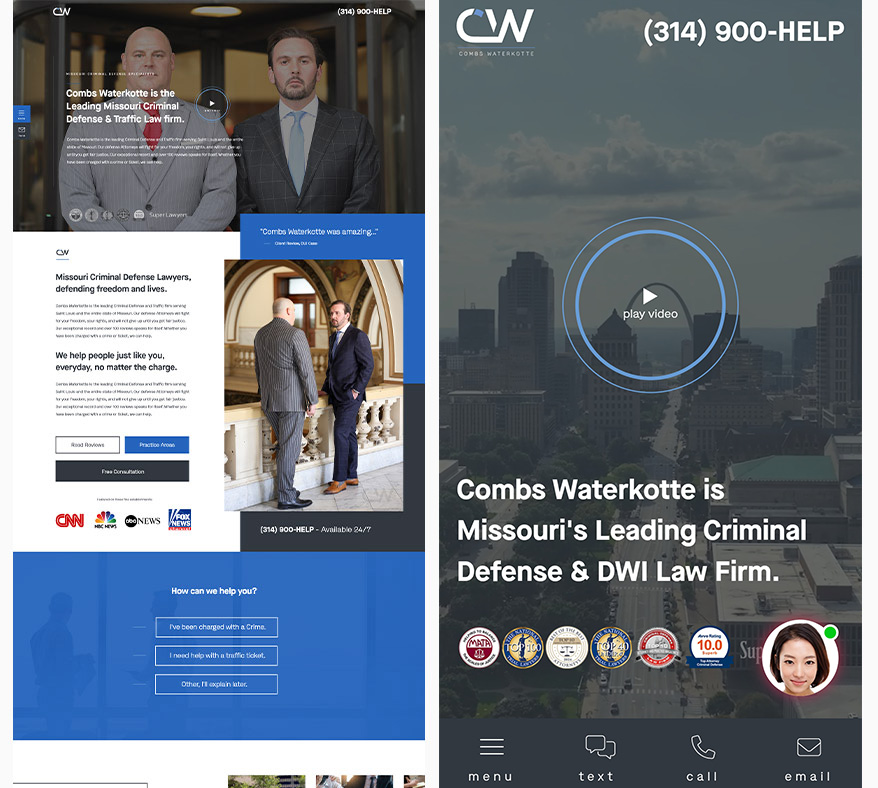
Many visitors evaluate a business on a phone before they ever see the full desktop version.
Mobile design should protect the important parts of the customer path: readable copy, visible proof, tappable phone or form actions, usable navigation, and pages that do not feel crowded or broken at smaller widths.
Inquiry paths should also match the situation. A legal lead, home-service quote, healthcare request, B2B consultation, and ecommerce purchase do not need the same form or same amount of context.
How Design Connects With Development and Search Visibility
Website design should give web development a clear structure to build and maintain.
It should also preserve the visibility and usability that matter after launch: important page destinations, redirects during redesigns, readable content architecture, mobile performance, and landing paths that help visitors act after finding the site.
Those search considerations are part of a larger website system. The design page stays focused on planning and presenting the customer experience, while technical build decisions belong on the development side.
Website Design FAQs
St. Louis Website Design FAQs
What makes website design different from web development?
Website design focuses on how the site is planned and presented for customers: messaging, hierarchy, navigation, mobile experience, proof, and conversion paths.
Web development focuses on how that experience is built, maintained, integrated, and supported technically.
Can WDAC redesign an existing website without replacing everything?
Often, yes.
A redesign should preserve useful content, rankings, images, proof, and page equity where they still support the business. The work should remove or reorganize material that is outdated, repetitive, unsupported, or no longer useful.
Should design decisions account for SEO?
Yes, when search visibility affects the business goal.
That may include page structure, content architecture, redirects, internal links, mobile performance, and clear landing paths. The page should still be designed for customers first.
Website Design
Design a Clearer Website Experience
Tell us what needs to improve: the current site structure, service pages, navigation, mobile experience, proof, forms, or the path from visitor to lead.